Showing posts with label Radio 4. Show all posts

Thursday, 28 June 2012

Dad's Last Tape

Following on from The House That Fall Into The Sea, I worked with Clare Jenkins from Pennine Productions again, this time on a BBC Radio 4 documentary entitled Dad's Last Tape.
Clare Jenkins explores why people record their life stories and what impact those stories have on other people when the interviewee is no longer themselves, or no longer alive. Twenty-five years ago, Clare recorded her father talking about his life: growing up in a Scottish tenement, being 'sold' as a farmer's boy at a hiring fair, a wartime stint in the RAF, working as a gardener to the wealthy, amateur poet. Jack Jenkins died 18 years ago, and Clare never listened back to the tapes - until making this programme. Broadcaster Rony Robinson never listened back to recordings he had done with his mother until Clare asked him to. Nor had singer-songwriter Sally Goldsmith listened to her mother, who died two years ago, singing May Day songs recalled from childhood. This programme explores the different circumstances in which people's life stories are recorded, and the memories and emotions that come flooding back when the tapes are eventually heard. We hear from the wife of a man suffering from dementia about her bitter-sweet feelings when listening to tapes of his voice. "They really calmed him and made him smile. And it was amazing for me, because I'd forgotten how funny he was." Another woman, terminally ill with cancer, has made a series of recordings for her newborn granddaughter as part of a hospice project in Sheffield. "I want her to hear about my life - and to know that I don't have a Yorkshire accent!" she says. We also hear from Mary Stewart of the British Library, who has been studying the way recorded interviews are used by and for those most intimately involved. Along the way, we discover the power of the beloved voice.

I needed to restore some of the recording but by and large they well remarkably good. Radio Times have chosen Dad's Last Tape as one of their recommendations for the week. This is what their reviewer Jane Anderson had to say...

There is nothing so effective in recalling the very essence of a dead loved one than hearing a recording of their voice. This gently edited programme mixes old recordings of elderly mothers and fathers with deeply moving stories of people facing death in the near future and their reasons for wanting to leave part of themselves behind for their families. Hankies at the ready.

"Gently edited", I'll settle for that. Once again it was a pleasure to work with Clare on what was for her a very personal programme. So if you can get to a radio at Monday 2d July you can enjoy it then otherwise take advantage of the BBC iPlayer for 7 days after that.


Wednesday, 11 January 2012

The Bishop and The Prisoner for BBC Radio 4

I have enjoyed working on this series of three half-hour programmes with Rosie Dawson for BBC Radio 4.  It was an excellent series that really got behind the issues and talked to real people both victims and criminals on how the system fails so many people.

In the three-part series, he talks to prison staff, politicians and inmates, who share their ideas about effective punishment both within prison and in Community Payback schemes. In an article in the Liverpool Echo he wrote...
“In The Forgiveness Project (piloted in High Down prison) a woman who was repeatedly raped, and who was only saved from death because her attacker’s knife broke, said forgiveness is fluid, which I thought was a fascinating phrase.
“She said ‘Sometimes I can forgive, sometimes I can’t forgive, sometimes I have to will myself to forgive’.
and we hear from some inmates about how sex offenders are probably the only group of offenders that cannot be re-habilitated and forgiven.

Bishop James put himself in the shoes of a prisoner being admitted to Liverpool Prison: 

“This included the clanging of the gates, the shutting of the cell door, measuring out the cell (12 paces by nine) and listening to the noise of the prison. Although I’ve been going into prisons for years it gave me a deeper experience of what it was like. And it is punishment.”
In this second programme, the Bishop visits training schemes which offer inmates a chance to gain new skills and may even guarantee them a job. The shoe manufacturer Timpsons has training workshops in Liverpool and Forest Bank; High Down is home to the infamous Clink restaurant where prisoners cook and serve Michelin-style food to members of the public.

In the final programme, James Jones meets ex-offenders taking part in a variety of probation initiatives in Merseyside designed to cut re-offending and "pay back" the community for crimes committed. Three men on the Persistent Priority Offender scheme commend the programme for providing the supervision they found lacking on earlier probation orders. In a moving interview a mentor with the service, Lynsey, says probation saved her from prison, crime and alcoholism and her children from life in care. There are some incredibly moving stories across the three programmes in this seriesand I can thoroughly recommend listening to the series. Bishop James proved to be an excellent and caring interviewer too.


 Listen to programme 1 on iPlayer

 Listen to programme 2 on iPlayer

 Listen to programme 3 on iPlayer

Friday, 5 August 2011

Human Kind - The story of scientist George Price


Just before I went on holiday I worked on a very interesting programme called Human Kind all about an incredible guy called George Price

Matthew Taylor tells the story of the last eight years in the life of George Price - a scientist who studied the evolution of altruism and who suffered for his faith. With contributions from Price's biographer Oren Harman, writer Marek Kohn, Professor Steve Jones and Price's family and friends, Matthew follows a journey that began with a sensational breakthrough in evolutionary biology and ended in poverty and suicide.
Audio Editor: Mike Thornton
Producer: Peter Everett.

Apart from being an incredible brain and scientist what struck me about his story is that it was so easy to become homeless and one of those people you see wandering the streets.  Also to get an insight into how people loose everything and become homeless. It could so easily be me or you....

It is well worth catching this programme on iPlayer before next Wednesday.

Friday, 24 June 2011

Shedtown - The finale on Radio 4 - The Storm

The shed, wooden icon of escape and isolation. Barry and Jimmy, friends since school days, find themselves slipping inexorably and almost unconsciously into middle age. Wednesday night saw the last episode of Shedtown.
Real storm clouds over Robin Hood Bay whilst we were recording

The Storm

A layer-cake of disaster threatens the creosoted community. And where’s Colin?
Cast:
Barry …… Tony Pitts
Jimmy & Johnny …… Kevin Eldon
Colin ……. Johnny Vegas
Diane …… Suranne Jones
Dave ……. Shaun Dooley
Eleanor …… Ronni Ancona
Deborah Dearden …… Emma Fryer
William ……. Adrian Manfredi
Carly …… Jessica Knappett
Father Michael …… James Quinn
Wes ……Warren Brown
Petshop Owner …… Caron May
Narrator…Maxine Peake
Music……Paul Heaton
Written and created by Tony Pitts
Sound Design by Mike Thornton
Directed by Jim Poyser
Producer: Sally Harrison
A Woolyback Production for BBC Radio 4.

The closing scene where the council send in bulldozers to demolish Shedtown was fun to create for radio. First a building storm through the episode then the arrival of the bulldozers, all normal stuff for a radio drama but then add the ice cream van pushing a shed into its hole and finally the storm rolling the bulldozer over and over with the council official Deborah Dearden inside was fun to create. Needless to say lots of layers in there but the break through sound was the sound of a steel rolling mill which gave me heavy rhythmic clanking as the steel went back and forth through the rollers. I then processed Emma’s screams so they span round and round.

Being buried alive on radio!

However there is another scene that is worthy of a little reveal into the magic of radio drama. It is where Dave and Diane are playing with their latest toy a ‘metal detective’ and they decide to bury Dave in sand using a snokel so he can breathe. The plan is that Diane will be able to find him because “there is metal in his fillings and foil in his cigarette packet”. Being radio of course we don’t actually need to bury Shaun, but some seroius acting was called for from them both as you can see from the pictures….

Stand back, serious acting taking place.

Wednesday, 15 June 2011

Shedtown review in Daily Telegraph

Gillian Reynolds Has written a lovely little review in The Daily Telegraph

We’re half way through Tony Pitts’s blackly comic series, about a strange seaside place where odd people live. At three in the morning someone is screaming. It’s the kind of thing that happens in Shedtown down by the bay, where dogs arrive as parcels in the post. It’s a bit like Under Milk Wood with touches of Father Ted. And it’s curiously addictive, the vivid, dreamlike script given life by a marvellous cast, including Suranne Jones, Ronni Ancona and Johnny Vegas as Colin (a thoughtful melancholic). Tonight: a puppet show about 9/11. 

Wow, "a bit like Under Milk Wood" praise indeed. This episode certainly had some sound design challenges, not least creating the unwrapping of a dog sent through the post in a parcel!! And the night screams were fun to record on the beach, we certainly got some very strange looks from passers by. All great fun.

Jim Poyser (Director) and James Quinn (Father Michael) at the end of the rainbow on the beach just after the puppet show scene

Friday, 10 June 2011

Another series of The Choice on BBC Radio 4

Radio 4 are running another series of The Choice which must be the 7th series on the trot that I have edited, the last 4 of which have been with producer Dawn Bryan. It is a series featuring people who have made life-altering decisions and exploring the whole process, from the original dilemma to living with the consequences.

This series has four episodes and the first 3 are available on iPlayer...
Episode 1 - Mikey Walsh

He grew up in the closed world of the Romany gypsies. Rarely at school, he seldom mixed with anyone outside his community with its colourful characters and strict family code. And despite its violence and hardships, it was the life that Mikey loved. Eventually he was faced with the agonising decision of whether to turn his back on everyone and everything he knew .....and face an alien world with no education and support... knowing he would never be able to return.
This programme really brought home to me both the strong community the Romany gypsies have, that is partially controlled by fear. But also the deliberate plans by some gypsies to take advantage and rip people off.

Episode 2 - Di Franks

When Di Franks asked her doctor about donating her kidney, she wasn't sure she would be taken seriously. Because Di wasn't giving her healthy organ to a sick and needy relative.. she wanted to donate it to a complete stranger. Five years ago it was illegal to give a kidney to someone you didn't know in this country.  When it was made legal, inspired by a friend in the US who had themselves donated a kidney, Di was faced with the extraordinary choice. Should she undergo a major operation to remove a vital organ to help someone she would probably never know ? Not only was she was risking her own life, the choice could have consequences for her son and the rest of her family if they ever needed her organ...
A powerful story of someone who wanted to help others but in a very different way.

Episode 3 - Joe Glenton

Joe Glenton was a bright young soldier, destined for leadership and intent on helping the local people, when he made his first trip to Afghanistan in 2006.  But what he experienced there led him to make the hardest choice of his life.. to honour his commitment to his colleagues and the people of Afghanistan or abandon his men, break his promise and run away to the other side of the world.
Joe's story made me even more aware of what war and killing does to individuals.

Episocde 4 - Professor Kevin Warwick

There will be more details on this rogramme on the Radio 4 web site next week.

But it is RIP The Choice after this. It is one of the changes Gwyneth Williams, the new controller of BBC Radio 4 has decided to make.

Shedtown - episode 2 on BBC Radio 4

Last night Radio 4 broadcast the 2nd episode of Shedtown, a 4 part comedy starring Johnny Vegas.

"Foundations" written by Kevin Eldon in which, Colin (Johnny Vegas) is all at sea as the foundations of Jimmy's dream take shape on the beach. Wes and Father Michael witness the profits of some not-so-spiritual meat.
Script conference on the beach


As you my remember I recorded this comedy drama on location in Robin Hood Bay last September and one of the challenges was to find a shed to record all the 'shed actoring' in. Sally Harrison, the producer had done some research and found 2 possible candidates. One was a small shed in the village itself, and the second was the score board hut at the local cricket club. Both had their merits so we decided to use them both for different scenes. The one in the village we used when Barry gets kicked out of the house and decides to live in the shed in the garden with his dog. But because it was in the village and it was full of visitors we had the fun of getting a complete take in without too many people in the background. We decided to use the cricket club shed for the sheds that become "Shedtown" on the beach. However part way through recording the shed scenes a local farmer decided to plough a field close to the cricket club so we had to time the 'takes' when he was at the far end of his field. However we were loosing too much time, so we abandoned the session and went and recorded some other scenes. The next time we returned to the cricket club, the farmer had gone but instead, not long after after starting again, we had a pitch invasion! A number of young people had been tasked to tidy up the ground and they had to do it that date. So we then had to search for yet another shed! We found one that belonged to the ice cream seller on the beach and he kindly cleared it out and so his shed enabled us to complete all the shed scenes for the series in one session and helped us get back on track.

Monday, 6 June 2011

Shedtown reviewed in The Observer

Miranda Sawyer in The Observer at the weekend has reviewed Shedtown. She wrote...

Shedtown, a new programme from Johnny Vegas's production company, was far from ranty: a strange drama/comedy/soundscape, narrated by Maxine Peake, it took advantage of its 11pm slot to offer something much more dreamy and hilarious than the usual wait-for-the-laughter Radio 4 fare. It's about the final works trip for the staff of a failed museum. They go to the seaside. The jokes came in under the radar: "What can I get you?" asked the barmaid. "Peace of mind," said Barry. "I want a pint, me," said Dave. The barmaid talked them through the new menu, which included chicken catch-a-Tory.

I am proud that she used 'soundscape' in her description of Shedtown as I worked hard to provide an aural wash of sound to support the narrative. More about the next episode soon....

Saturday, 28 May 2011

Shedtown - Radio 4 comedy series starts on 1st June

I have to go back to early September where for nearly a week the cast and crew lived and worked in Robin Hood Bay recording Shedtown on location before the weather broke too much.  Ha ha, the British weather kept us on our toes and made umpteen schedules out of date almost before they had come out of the printer.

The view out to sea showing some of the bad weather coming in!

The frst episode is called "Something is Gonna Change....


Who hasn't thought about running away from it all at some time or other? Throwing caution to the wind, wrenching oneself out of a long established orbit to head for the deep space of the unknown?
Barry (Tony Pitts) and Jimmy (Kevin Eldon) haven't. Until now. Friends since school days in a small town, they find themselves slipping inexorably and almost unconsciously into middle age.  Shedtown is a dream born out of quiet desperation. Throughout the series our wooden icon of escape and isolation 'the shed' becomes a symbol of possibility and change; a new community by the sea where our heroes can circumnavigate the mundane, once and for all.  It's the works day out for the workers of Blakeley Industrial Museum - and something's got to change.

Cast:
Barry ...... Tony Pitts
Jimmy & Johnny ..... Kevin Eldon
Colin ..... Johnny Vegas
Diane ..... Suranne Jones
Dave ..... Shaun Dooley
Eleanor ..... Ronni Ancona
Maureen ..... Emma Fryer
William ..... Adrian Manfredi
Nicky ..... Caron May Carly
Yvonne ..... Jessica Knappett
Father Michael ..... James Quinn
Wes ...... Warren Brown
Narrator ..... Maxine Peake
Music ..... Paul Heaton
Sound Design ..... Mike Thornton
Written and created by Tony Pitts
Directed by Jim Poyser
Producer: Sally Harrison
A Woolyback Production for BBC Radio 4.


Shedtown cast outside Unit Base at Robin Hood Bay

We had to record 4 episodes in 4 days across a range of locations, not least of which was finding a shed to record in. Of course we couldn't find a shed by the beach to record in so what did we do, well you will have to wait until next week before the second episode. I don't want to give the game away!

Anyway you can listen to episode 1 on Wednesday 1st June at 23:02 or if you miss it then pick it up on the Radio Player.

Sunday, 8 May 2011

Monty Python's Fliegender Zirkus! on BBC Radio 4

A programme I worked on a while back has just gone out. It really is the last programme from All Out Productions. It is all about how Monty Pyton went over to Germany to make some TV programmes for German TV...


2011 marks the 40th anniversary of one of the Monty Python team's most bizarre and least known television adventures, two forty five minute specials they made exclusively for German television.
Roll up, it's Monty Python's Fliegender Zirkus! This is the extraordinary tale of when the Pythons went Bavarian. Michael Palin, Terry Jones and Alfred Biolek, the man who persuaded them to take their comedy to Germany, all talk about how life on set began to imitate a Monty Python sketch.
German Comedy Ambassador, Henning Wehn, tells the story of how in 1971 the Pythons were flown into Bavaria, full of new original ideas for sketches, including pieces about the German artist Albrecht Durer, William Tell and The Merchant of Venice. They also adapted the popular Flying Circus Lumberjack Song into German and planned to sing it with the Austria Border Police Choir.
Only Michael Palin and John Cleese were capable of delivering lines in 'understandable' German. Despite extensive language coaching, Eric Idle, Terry Gilliam, Terry Jones and Graham Chapman were virtually incomprehensible. This may have added to the Pythons' trademark absurdity and surrealism, but confused the bejeebus out of the German TV audience. Realising this dream was becoming a nightmare, Alfred Biokek took the decision to make the second programme in English, with German subtitles added later. It proved to be a major hit on German TV, but all concerned decided it best not to repeat the experience. Monty Python's Fliegender Zirkus! hears from Terry Jones, Michael Palin and Alfred Biolek about how they came up with the material for these special versions and listening to clips from both programmes, asks whether 'Pythonesque' really works when translated into German.
Presenter: Henning Wehn
Edited: Mike Thornton
Producer: Jo Meek
An All Out production for BBC Radio 4.

We had great fun with this programme adding a number of 'Pythonesque' moments along the way. If you didn't catch it on Saturday then grab it on iPlayer whilst you have the chance. There are some lovely stories of their experiences of their time in Germay as well as the challenges of making Monty Python work for the German humour and how some jokes didn't translate. You will hear that they can still sing the Lumberjack song in German to this day. For any Python fan this programme is a must, and even if you aren't, you will still find it very entertaining.

R.I.P All Out Productions

Thursday, 7 April 2011

The Sub 2-Hour Marathon: Sport's Holy Grail on BBC Radio 4

Next Monday 11th April at 8pm sees BBC Radio 4 broadcast a documentary about developments towards potentially being able to run a marathon in under 2 hours. This was one of the last programmes I worked on for, the now defunct, All Out Productions....


Sixty years ago, people said the four minute mile was impossible: in 1954 they all gasped in disbelief when Roger Bannister proved them wrong. They also said the 100 metres would never be run in under 10 seconds and shuddered again when Jim Hines did just that in 1968. Will the 2 hour marathon be the next great sporting barrier to be broken or will it remain beyond human endeavour? The question polarises opinion among athletes, sports scientists and commentators worldwide.
BBC reporter and marathon runner Chris Dennis will explore whether it's physically and mentally possible to run 26.2 miles in 120 minutes.
In the hills around Addis Ababa, the current world record holder Haile Gebrselassie tells him what it felt like to run the distance in 2 hours 3 minutes 59 seconds, how close to the limit he pushed his body, but why he is still convinced the two hour barrier will be broken in the next 20-30 years. Other elite athletes, including the women's marathon world record holder Paula Radcliffe and London marathon Race Director Dave Bedford also explain when and how they think it will happen.
The Olympic champion Sammy Wanjiru will argue that the sub 2-hour marathon is simply a pipe dream, a landmark too far. The Secretary General of World Marathon Majors, Glenn Latimer, who has worked with many of the world's leading athletes for 30 years also has serious reservations.
Chris also heads to Loughborough to the English Institute of Sport to meet Dr Barry Fudge who gets him on the treadmill so he can experience first-hand what it feels like to run a mile in 4 minutes 35 seconds, the pace required for a sub 2 hour marathon.
Presenter: Chris Dennis
Edited: Mike Thornton
Producer: Jo Meek
An All Out Production for BBC Radio 4.

There are two special moments for me in the programme. The first is when the presenter, Chris has a go at running on a treadmill at the sub 2 hour pace, and manages about 10 seconds, whilst commentating on his own achievement. The second is a sequence towards the end of the programme where Chris interviews a marathon trainer whilst running out in Addis Ababa. I supplied Jo with 2 headset mics so that she could plug them into two  Zoom H2 recorders, one on the Chris, and the other on the interviewee. and then we synced up the two recordings in the edit.
Especially if you are into running, or any sport, do try and listen to this programme as it explores the limits of human physical activity. If you do miss it then find it on iPlayer

Sunday, 6 March 2011

On The Bench on Radio 4

Another programme I finished editing last week was "On the Bench". No not football but all about Magistrates Courts.

This year marks the 650th anniversary of the appointment of the first Justices of the Peace in England and Wales. But many magistrates courts are now facing closure as part of the cost saving measures announced by the Ministry of Justice.  So how valuable is the role played by local magistrates and what impact will the court closures have? Jenny Cuffe has been following developments in Salford where the Magistrates court is one of those on the hit-list. The ageing listed building which houses the court dates back to the early nineteenth century - but the court itself has been involved in current initiatives including special domestic violence courts and a pilot scheme in restorative justice.  As local politicians battle to stave off the closure, Jenny Cuffe follows day-to-day business - talking to magistrates, lawyers and their clients, and assessing the claims of those who say justice needs to be delivered locally. 
Edited: Mike Thornton
Producer: Jenny Cuffe
Editor: David Ross.

This programme takes a look at not only what Magistrates can and cannot do but we hear from some of the people affected by the decisions Magistrates make both defendants and their families. Jenny has a knack at being able to ask the obvoius questions of folk and get them to talk to her openly. There is a ponient moment towards the end where we hear the family shouting to a loved one in a prison van as it drives off to take him to prison.

Do listen tomorrow at 8pm if you can or grab it on iPlayer after the programme has finished.

In Doubt We Trust on BBC Radio 4

I finished editing these two programmes earlier this week and 2 very interesting programmes they are too. Programme 1 went out today and is on iPlayer here for the next 7 days.  If you missed it then do catch it this week.


Are we fooled into thinking we know it all? Has the immediacy of information and knowledge created an illusion that we have all the answers and therefore don't want or feel the need to challenge or doubt our actions and the world around us? Mark Vernon came face to face with these issues having studied physics, been ordained in the Church of England and then lost his faith. In this programme he looks at why we have a lust for certainty and are loosing our ability to doubt and question well. "Doubt has become a bad word. It's associated with fear and failure" he says. But how have we arrived at this situation? Why do we feel uneasy if politicians or religious leaders express doubts in public? Mark looks at how this attitude has affected the worlds of politics and finance. And tries to see whether a mistaken view of science and the way our brains work might give us answers.
Edited by Mike Thornton
Producers: Amanda Hancox and Rosie Dawson.

Programme 2 goes out on Radio 4 next Sunday at 1:30pm....

"We take things very personally at the moment. People get very disturbed and angry when their certainties about themselves and their world are questioned." So says the philosopher Angie Hobbs. But why? In this programme the writer Mark Vernon, who himself had a crisis of faith, looks at our attitudes towards doubt and certainty. In conversations with David Jenkins, the former Bishop of Durham, Karen Armstrong, Ann Widdecombe and a variety of scientists and philosophers, he explores the art of doubting and our the ability to question well. He discovers that if we can master this art, it can help us to flourish and become more fully human.
Edited by Mike Thornton
Producers: Amanda Hancox and Rosie Dawson.


I enjoyed these two programmes especially because Amanda and Rosie haven't restricted themselves to the classic 'doubt zone' of religion annd faith but extended it to science and politics. In programme 1 it was very interesting to hear that we still expect to have certainties from our politicans but hammer them when they get it wrong.
In programme 2 it was very interesting to hear that science, an area that one would normally expect to be full of certainites, is actualy full of doubts because we cannot be sure of how things happened, we can only theorise about them and may be able to disprove a theory at some point later. It was also interesting to hear Mark talk about lack of certainty in faith beng a good thing and that if he had got the certainites he was looking for then it actually wouldn't be worth the paper it was written on.

Thursday, 24 February 2011

Tim Davies responds to BBC Trust report on radio in the Radio Times

This has been posted on the Radio 4 blog...

In the Radio Times, BBC Radio boss Tim Davie has written a response to the substantial public debate about the Trust's review of Radio 3, Radio 4 and Radio 7. He endorses the suggestion that Radio 4 broaden its audience:
The idea of making more people aware of Radio 4 makes sense: there are so many programmes waiting to be discovered.
And denies that this means reducing standards:
The station's commitment to quality - whether drama, comedy or programmes from the radio archive - should offer further comfort to those who fear "dumbing down".
He suggests that readers looking for evidence of the health of the network dip into the Radio 4 programme directory - and that particular richness awaits listeners in programmes beginning with the letters 'B' and 'M'. Read the whole of Tim Davie's article on the Radio Times web site.


It is more accurate to say that Tim Davies has responded to the Trusts report regarding Radio 4. He is strangely silent on Radio 3.

Monday, 14 February 2011

I Heart Milton Glaser on BBC Radio 4

This is an axcellent piece of storytelling by producers Jo Meek and Gillian Donavon about how the the iconic "I Heart New York" logo came about. It was a lovely programme to have been invloved in and I can throughly recommend trying to catch it on iPlayer before it expires.


It was 1977 and New York State needed a new ad campaign. Crime was rampant and the city's coffers were empty. Businesses (and their employees) were leaving the city in droves, and tourism was suffering. The State turned to Madison Avenue, who, in turn looked to young graphic designer Milton Glaser. Expecting it only to 'be a three-month campaign', Glaser donated his back of a taxi doodle for free; 'it was like one of those things you bang out because it didn't seem to merit any more attention'. Skip forward nearly 25 years, and the I (Heart) NY design remains one of the most recognizable pieces of design in the world. Still cited on licensed and unlicensed merchandise across the city and internationally, it's has taken on a life of its own. In this Radio 4 programme the art critic Alastair Sooke heads to New York to meet Milton Glaser, who is the personification of American graphic design. As Alastair discovers Glaser has designed everything from a 1967 Bob Dylan Greatest Hits Album cover, to the DC Bullet adorning every DC comic for nearly 25 years, yet he still finds himself remembered for the aching simplicity of the I (Heart) NY design. Speaking to some of Glaser's contemporary graphic designers and critics, I Heart Milton Glaser explores a form of art that surrounds us every day and traces our society's relationship with a design that became one of the most iconic images we know.
Presenter: Alistair Sooke
Sound Design: Mike Thornton
Producers: Jo Meek & Gillian Donovan
An All Out Production for BBC Radio 4.

I didn't know that they had reworked the icon after 9-11 and Milton didn't earn a penny for it as he thought it would be a short local campaign.  Alistair is also an excellent presenter and a real pro. When we were recording the links via ISDN into my studio, he delivered just the right amount of emotion into them and so many were first take.
You can also find an article in The Daily Telegraph

Tuesday, 8 February 2011

Radios 3, 4 and 7 must build reach, Trust review finds

BBC Radios 3, 4 and 7 are to remain on air, but must work to build audience reach while remaining distinctive, a BBC Trust review has concluded.

The reports which are available on the BBC web site go onto to say...

Radio 3
We have set out a number of specific actions for BBC management which include:
looking for ways to make the station more accessible and welcoming
  • considering how the BBC can best deliver classical, jazz and world music to all licence fee payers
  • considering how the station can help audiences best navigate the wide range of content on offer
  • reviewing the levels of broadcast output from the performing groups

For me this is one of the more expensive stations when looked at a per listener at a cost per user per hour or 6.3p copared to Radio 2 at 0.5p peruser per hour.


Radio 4
Whilst Radio 4 is the most expensive BBC radio service, audiences felt that it represents excellent value for money overall. We endorse Radio 4’s strategy of broadening its core appeal where possible and believe that the station should continue to evolve to replenish its audience. In addition:

  • Radio 4 should to aim to increase appeal amongst different demographic groups
  • We have increased the minimum hours of original documentaries required in the Radio 4 service licence
  • BBC management should consider Radio 4’s role in sports coverage. This consideration should take into account Radio 4’s role within BBC radio’s overall sports coverage.
  • Radio 4 should consider the balance of its international coverage and in particular, its coverage between Europe and the rest of the world, compared with America.

Although I agree with the lack of coverage on Europe, I do hope Gwyneth Williams doesn't just cut Americana, fronted by Matt Frei. I do enjoy this programme as it shows a different side to American culture to most other reporting channels. The increase in original documentary hours is good news, especialy if they end up in the independent sector.

Radio 7
Radio 7 is highly regarded by a sizeable digital audience who value the light hearted and nostalgic output. Audiences appreciate the opportunity to hear the best examples of radio comedy and drama from the BBC archive. Radio 7 also plays an important role in promoting DAB. However, Radio 7 has very low awareness overall and its dedicated children’s programming is not serving audiences well.

That's all they say about Radio 7 in the summary report.

The summary cncludes with a list of key strategic initiatives which the BBC management have made and the Trust endorses...

  • The development of part of its public service archive proposition into what the BBC terms ‘permanent collections’ for Radio 3 and Radio 4. These proposals will increase the amount of archive programming made permanently available on the Radio 3 and Radio 4 programme sites.
  • The repositioning of Radio 7 as Radio 4 Extra. However, we will protect the current elements of Radio 7 that audiences particularly value, including increasing the weekly minimum amount of drama and comedy and setting limits around the amount of Radio 4 catch-up programming.
  • The development of the children’s audio strategy including the refocus of dedicated children’s programming on Radio 7 to appeal more to families. This will also include the creation of CBeebies pre-school audio available for download from the CBeebies website and the commercial release of children’s radio archive programming for secondary broadcast by third parties.

As a listener I like the increase in permanent collections although dealing with the 'rights' issues would come cheaply I suspect. I do like the idea of making Radio 7 into Radio 4 Extra. Also I agree with the drive to increase the audience profile and encourage more younger listeners, after all these will be the next generation of listeners.

Monday, 24 January 2011

Gwyneth Williams: controller of BBC Radio 4 'To keep good, Radio 4 must change'

Ben Dowell from The Guardian has interviewed Gwyneth Williams, the new controller of BBC Radio 4 three months into her role, but when asked recently by John Humphrys recently about leaving the network alone because Mark has left it in such good shape said "To use the cliche, in order to keep it good it must change," So we can expect to start to see changes in Radio 4 to keep it on top and she is starting to announce some of those changes now after a 3 month consultation process. If you want to read the full article then go the Ben's article on the Media Guardian site. But here are a few extracts that I found interesting...


It would be hard to imagine Damazer walking around the office without shoes, as Williams is wont to do. Or describing Humphrys as "incredibly sweet", as she does at one point. In fact, following her appointment, Williams spent her first weeks talking to staff, trying to "make sense" of the network and "understand it as an organic thing". "It is not as if Mark didn't listen – far from it – but he was a very authoritative presence and there was more of a sense that he said what was what," says one in-house producer. "You feel that things will be different under Gwyneth."

So it looks as if we will see the softer side of Radio 4, that was submerged under Mark's tenure, re-emerge.

One immediate difference will be felt once her proposal to cut the number of commissioning rounds a year from two to one is implemented; this will allow a looser process of "continuing commissioning", intended, she says, to reduce bureaucracy ("I know everybody says this and it is probably easier said than done"), with producers given more freedom to pitch ideas at other times. "I am really keen to add a layer of creativity," Williams explains. "Having met the producers and the people, I know that is perfectly possible and can happen. If we can't take creative risks at this point, with Radio 4 in such a good state, then we never can."

I have mixed views about this, as someone from the regions, loosing a commisioning round potentionaly reduces the face to face contact with the commissioning editors by 100% as it isn't very easy to pop into see any of them from up this end of the country. That said if this flexibility to pitch ideas at any time is real then I welcome it with open arms. There have been many times when an idea has surfaced but it hasn't been worth pursuing because by the time it had been commissioned, made and delivered it would be so out of date or not relevant any more that it probably wouldn't have got commissioned anyway!

There are no specific proposals to expand news bulletins such as The World at One or The World This Weekend. Nor is she planning to change the roster of Today presenters in spite of the rumoured interest of the BBC's political editor, Nick Robinson (although she does have hopes to "get more women on the network"). Instead, reporters such as Robinson will have a chance to exercise their interviewing skills on a new autumn show – a 15-minute slot on Tuesdays at 9.30am in which the BBC's army of reporters will be free to quiz whoever they like from whatever fields. There will also be a boost to science coverage in the half-hour slot preceding this. Williams is axing the existing rota of Tuesday 9am interview shows, Taking a Stand, The Choice and On The Ropes, in which people recount extraordinary experiences in their lives. The thinking is that interviews of this type are replicated on other programmes (such as Saturday Live and Broadcasting House) and they no longer need a designated place in the schedule.

I have to say that I am personally disappointed that The Choice is going as I have edited over 5 series of this illuminating programme, where you have time to really hear someone's story in detail that I don't believe you will get on either Saturday Live or BH. Neither of these programmes give a 28 minute slot to one interview and even these 15 minute slots (which are 13'30" really) will enable a very deep exploration of an issue. That said Gwyneth is planning to use the Tuesday interview slot to increase the profile of science on the network and I commend her for that.

"There is a quieter bit to Radio 4, science and information, which is a bit buried in the schedule," says Williams. "It is a potential heartland for Radio 4 which could beat more loudly for people who want to come to Radio 4 for understanding. We want to add in the quieter exploratory and analytical voices of scientists." Another plan is to give what will in effect be grants to "around five or so wise men or women" each year to "go off and do their own research". Thinkers of any kind would be given the money and the time to spend a year "tracking how we live now".
and from the Radio 4 blog she said....

From October I plan to launch a new 9 a.m. science programme - not about the ideas of science which Melvyn Bragg covers regularly in the brilliant In Our Time - but about science and working scientists, about the scientific method, across a range of subjects: physics, biology, engineering, technology, natural history. The Science Department will lead the work on developing this and I have been talking to various people, among them Jim Al-Khalili, a scientist and an experienced broadcaster, about possibly presenting it.

These plans will in my opinion help to redress the balance of Radio 4's output that under Mark made it into a relatively hard news station but it looks as if  Gwyneth is going to give more space to reflection and considered analysis.

"I want [Radio 4] to be more easily modern and forward looking and perhaps slightly more relaxed and more creative and to add that to the intellectual rigour,"

Tuesday, 11 January 2011

Vines on the Front Line on Radio 4 tomorrow

Vines on the Frontline is another programme I have had a hand in will be broadcast on BBC Radio 4 tomorrow. It is a totally unexpected concept from an area we consider to still be torn apart by war and terror. Do have a listen if you can and if you miss it then pick it up off iPlayer.

For Radio 4, the BBC's Middle East Editor, Jeremy Bowen, takes time out from reporting conflicts to give vinophiles a new perspective on an ancient story. Lebanon is not a place you naturally associate with winemaking. It is a Middle Eastern country nestled between Arab neighbours whose religion forbids them to drink alcohol. It is also a country that has been scarred by war, from the 15-year civil war from 1975-1990, to the recent Israeli-Lebanon conflict in 2006. But Lebanon is also an ancient civilisation, a country of merchants and traders - its history dating back to Noah, the first winemaker in the Bible. Fittingly the Temple of Bacchus, an impressive tribute to the God of wine, is situated amongst the ruins of Balbek, in the Bekaa Valley, a region these days better known for Hezbollah than hedonism. But the temple, like Lebanese wine, has survived centuries of war and the winemakers of the Bekka are optimistic wine will outlive war. Sharing stories with the wine makers who, in defiance and dedication to their craft, continue to grow their vines so close to the frontline, Jeremy delves into the cultural and ethnic mosaic of this unstable but extraordinary country.
Present:  Jeremy Bowen
Edited, and mixed: Mike Thornton
Producer: Gemma Newby
An All Out Production for BBC Radio 4.

Tuesday, 4 January 2011

Update - The Guardian review on Story of King James Bible series

Elisabeth Mahoney has written a very nice review in The Guardian of The Story of King James Bible series I worked on and blogged about.

The Story of the King James Bible (Radio 4) is a luxurious thing: three programmes, over three days, tracing the history of what presenter James Naughtie described as "a literary masterpiece" for "people of many faiths, and none". Yesterday's opening instalment, recorded at Hampton Court, revelled in detail and evocative soundscapes as Naughtie and gathered experts moved through the palace: footsteps on stone stairs, the sudden whoosh of boomy sound as they move into a particularly high-ceilinged space; classy readings from the Bible. Naughtie probed his guests with questions that got beneath the surface of a historical event – a conference held at Hampton Court in 1604 – to draw a picture of the meeting in all its religious and political complexity. There was a strong sense of everything in flux as James I ascended the throne, and also the monarch grabbing his chance to re-emphasise the relationship between king and church as a divine, rather than earthly, institution. He had disliked the earlier Geneva Bible, we heard, because of annotations in the margin, especially one that appeared to question the king's authority. In his Bible, "there were no marginal notes that were interpretative". The conference was rumbustious, with those gathered shocked by James's coarse language. "I give a turd for your argument," he told one Puritan speaker.

Thanks Elisabeth for the kind words. Here are another couple of pictures I took in Oxford.
We was there!


Another bible to study

Monday, 3 January 2011

The Story of the King James Bible on BBC Radio 4

I worked on this series with producer Rosie Dawson but unlike most documentaries I work on, where I usually do the editing and mixing, with this series I was also involved in the recording too. This was because the whole series was recorded on location, no studio content at all, not even the presenters links, and so Rosie didn't want to have to worry about being the sound recordist as well as the producer as the recording schedule was going to be tight.

The series of 3 programmes are going out today, tomorrow, and Wednesday at 9am with a shortened repeat at 9:30pm. Do try and catch the longer version either live or via iPlayer. Even the podcast seems to be the shorter version of the programmes. The first programme "The Commission" went out today...

The King James, or Authorised, Version of the Bible remains the most widely published text in the English language. It has been called the "noblest monument of English prose" and has been recognised for centuries as both a religious and literary classic.
In the first of three programmes marking the 400th anniversary of its publication, James Naughtie tells the story of how and why King James VI of Scotland and I of England decided on a new translation of the Bible. The programme is recorded at Hampton Court Palace. A conference here in early 1604 led to the commissioning of the King James Version. The Chief Curator at the palace, Lucy Worsley, and James Naughtie walk the palace grounds, scene of so much Tudor and Stuart frivolity, and a refuge from the plague. Before the earnestness of the January conference there had been masques and feasting and Shakespearean drama. England was still revelling in its new monarch after the stultifying later years of Elizabeth's reign and breathing a sigh of relief that the accession had been a smooth one.

We recorded in the quad by the gates, having to wait for the crews to stop building the ice rink that was set up outside Hampton Court. Then on into the Chapel Royal, the Great Watching Chamber, then through the palace and into the King's state apartments. In the main banqueting hall we had a very 21st century problem with an electrical buzz that we couldn't find the source of, but were able to find a spot where it was quiet and then modern technology removed the rest. We were also plagued by another 21st century challenge on the night we were recording, Heathrow's flight path was right over Hampton Court so we kept having to stop as a plane went over head.

Tomorrow's programme "The Translation".....

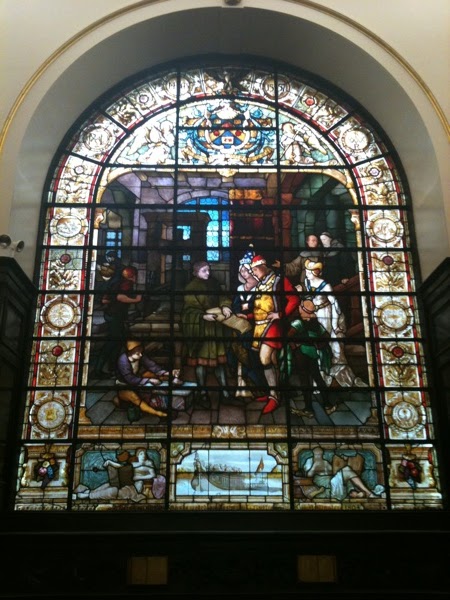
The programme opens in the main quadrangle of the Bodleian library. A statue of King James stands high over the courtyard, books in hand. The King loved the Bodleian. In a visit there in 1605 he said that he would love to spend his life chained alongside the library's chained books. The translators in London, Cambridge and Oxford drew on several earlier translations of the Bible as they went about their work. In the chapel at Hertford college, Oxford, Jim sees a stained glass window of William Tyndale, the first man to translate the Bible into English directly from Hebrew and Greek. The translators drew heavily on his work. Many of the phrases that come to mind when we think of the King James Bible are in fact those of Tyndale. The translators had several other Bible translations at their disposal too. Each had their own agenda; the Great Bible with its frontispiece depicting the idea of Royal Supremacy; the Puritans' Geneva Bible which challenged that very idea.
The Stationers Hall

We recorded this programme in both Oxford both inside and outside Bodleian library, in the Tower room at Corpus Christi college and a lovely moment there where we went into the chapel and interrupted a choir rehearsal to have a look at some pictures there, as well as The Stationers Hall in London, all on the same day!

James is shown two extraordinary documents which reveal how the translators worked. One, a 1602 copy of the Bishops Bible, contains annotations made by the scholars suggesting alternative translations. The other is a copy of notes made by one which reveals the mind of the revision committee which met to review the translations of all the companies.


The final programme in the series on Wednesday is called "The Legacy"...


He begins in the pub. James meets linguist and Renaissance scholar Gordon Campbell, the Jamaican poet Kei Miller and Rachel Holmes from the Southbank Centre to discuss the surprising and unusual places we hear of the King James today. "Salt of the earth", "skin of their teeth", "Apple of his eye" are all phrases that have come into the English language through the King James Bible, but do any of the drinkers in the pub know this? The King James Bible became part of our everyday speech because of the role that Christian belief and practise has played in our national story. Jim will meet Giles Fraser at St. Paul's Cathedral to discuss the central place of the Bible and Christianity within British culture. For 300 years the King James Bible reigned supreme. Nearly everyone went to church and the King James Bible was the only translation to be used. Preachers would draw crowds of over a thousand and the words of the King James gradually worked their way into the blood stream of all those in the country.


We started recording in St Paul's before it got too busy before moving on to the pub and ending up in the South Bank Centre where we were troubled by trains coming in and out over The Thames.

Then before Christmas, Rosie did a rough edit to get the content in the right order and choose the best versions of the answers and then I worked my magic to mould it all together with some readings, music and the soundscapes I also had recorded on location.

All in all it has been a challenging and rewarding series to work on. I do hope you enjoy listening to it as much as I have enjoyed being involved in making it.